Potential Robotic Lifebuoy: Autonomous Water Rescue USV
Role: Robotics Engineer Company: Potential Engineering Pvt. Ltd., Mumbai, India Platform: Custom USV | ArduPilot | ROS | RTK GPS | Drone Integration
Overview
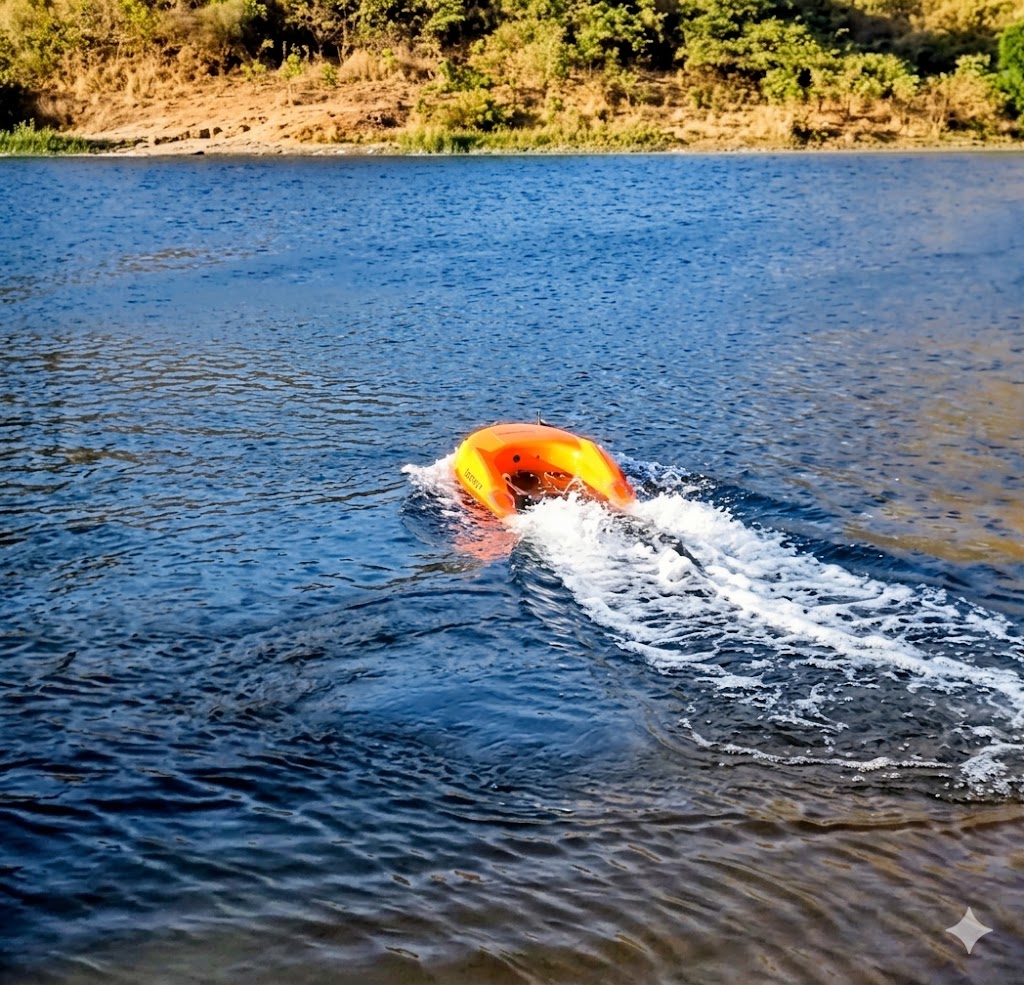
Drowning claims over 300,000 lives annually. The average response time for a human lifeguard to reach a victim is 2–3 minutes often too late. The Potential Robotic Lifebuoy is an autonomous surface vehicle designed to close that gap, reaching a person in distress faster than any human responder while carrying enough buoyancy to support 140 kg.
Built from HDPE, powered by BLDC motors, and guided by GPS autopilot, this isn't a remote-controlled toy. It's a deployable rescue system capable of operating fully autonomously — from victim detection to autonomous navigation and recovery.
The Problem
Traditional water rescue has two failure modes: response time and operator skill. By the time a lifeguard spots a drowning person, deploys, and swims out, the window for survival has already narrowed. Remote-controlled alternatives still require a trained operator with line-of-sight. Neither solution scales to unmanned beach stretches, night operations, or rough water conditions.
The Lifebuoy needed to be fast, autonomous, and deployable by anyone.
Key Specifications
Parameter | Value |
|---|---|
Speed | 10 km/h |
Payload Capacity | 140 kg |
Operational Range | 1.5 km |
Runtime | 45 min |
Hull Material | HDPE |
Propulsion | Dual BLDC motors |
Navigation | RTK GPS + Autopilot |
Software Stack
The full autonomy stack runs on ArduPilot with a ROS middleware layer handling sensor integration, state estimation, and mission execution. The system supports three operational modes: fully manual for operator-guided deployment, assisted mode with stabilization, and fully autonomous waypoint navigation driven by GPS-based mission planning.
Core Stack:
ArduPilot (flight controller firmware, adapted for surface vehicle)
ROS (sensor integration, mission management, telemetry bridge)
MAVLink / MavROS (GCS communication and command relay)
Holy Bro telemetry radio (bidirectional real-time telemetry)
Custom mission planner UI integrated with PotOS GCS
RTK GPS & Waypoint Navigation
Standard GPS gets you to within 2–5 meters. In a rescue scenario where a victim is treading water in a specific location, that's not good enough. The Lifebuoy uses RTK GPS for centimeter-level positioning accuracy, enabling precise autonomous deployment to a target coordinate.
The waypoint navigation stack is built on ArduPilot's AUTO mode with a custom ROS mission planner on top. An operator — or the drone detection system drops a GPS coordinate, and the Lifebuoy autonomously plots and executes the intercept path, handling heading, throttle, and obstacle response without any manual input. On arrival, the vehicle holds station until the victim grabs on, then autonomously returns to the launch point.
Auto Flip Handling & Thruster Reversal
A surface vehicle in choppy water will flip. It's not a question of if — it's when. Most USVs become useless the moment they turtle. The Lifebuoy handles this differently.
An onboard IMU continuously monitors roll and pitch. When a flip event is detected, the autopilot automatically reverses the thruster direction and applies a correction sequence to self-right the vehicle. No operator intervention required. The vehicle rights itself and resumes its mission because a rescue that fails because the robot flipped over is worse than not deploying at all.
Telemetry System (HolyBro)
Real-time situational awareness is handled by a HolyBro telemetry radio system providing bidirectional MAVLink communication between the vehicle and the ground control station. The telemetry stream surfaces:
Live GPS position and heading
Battery voltage and estimated runtime remaining
Motor RPM and current draw
Mission status and active waypoint
IMU orientation data
Fault flags and exception states
All of this feeds directly into the PotOS GCS interface, giving the operator a full picture of vehicle state without needing line of sight.
Drone + Lifebuoy Integration
The Lifebuoy alone is reactive — it needs a coordinate to go to. The drone integration makes the system proactive.
A drone deployed from the same station performs aerial surveillance of the water surface, feeding live video to an onboard inference pipeline trained on MOBDrone drowning detection dataset via Roboflow. The model detects persons in distress in real time, extracts their GPS coordinates from the drone's RTK position and gimbal angle, and automatically queues a rescue waypoint for the Lifebuoy.
The full pipeline looks like this:
The operator doesn't need to do anything except deploy. The system finds the victim, dispatches the vehicle, and executes the rescue.
Detection Pipeline
Model: Custom object detection model trained on MOBDrone drowning dataset
Training Platform: Roboflow (annotation, augmentation, export)
Inference: Onboard drone compute, real-time at operational frame rate
Coordinate Extraction: Fuses drone RTK GPS, altitude, and gimbal orientation to project detection into world coordinates
Integration: Extracted coordinates injected directly into ArduPilot mission via MAVLink
Results
Autonomous deployment and victim intercept validated in open water trials
Self-righting flip recovery demonstrated under real conditions
RTK GPS positioning enabling accurate autonomous navigation to target coordinates
End-to-end drone-to-rescue pipeline tested with MOBDrone-trained detector
10 km/h top speed enabling faster-than-human response times at range
Key Takeaway
This project sits at the intersection of autonomy, perception, and real-world impact. Building a system that has to work the first time, every time, in unpredictable water conditions — with no operator in the loop — forced every engineering decision to be both technically sound and failure-tolerant. The Potential Robotic Lifebuoy is what happens when you take robotics seriously and point it at a problem that actually matters.